📌 Project Note & Acknowledgments

This project originally began as a collaborative class assignment during our college studies, developed alongside my colleagues McKenzie Cadell and Kaleigh Wills, whom I deeply appreciate, admire, and respect.

The exercise charts included below were created as part of our shared research and pedagogical exploration of healthy flute practice habits. While the foundation of this work was developed collectively, we all agreed that the material could continue to evolve independently as each of us pursued our own artistic and scholarly paths.

This article represents my individual contribution to that ongoing research. It expands upon our original work by organizing the material into a structured, accessible format intended for performers, educators, and students.

Laura A. Zambrano
Why Musicians Should Think Like Athletes
How many of us have heard the comparison between professional athletes and musicians?
Athletes are frequently visible when injured, receiving medical care, media attention, and public support. This visibility helps normalize injury as part of their profession and removes much of the stigma around physical recovery.
Musicians, however, often work in a very different environment. Our work is less visible, less publicly supported, and frequently misunderstood as non-physical. Yet the reality is that many musicians practice three to five hours per day—or more, often in isolated and physically demanding conditions.
This raises an important question:
If athletes prepare their bodies for performance, why wouldn’t musicians do the same?
Static vs. Dynamic Tension in Performance
A key difference between athletes and musicians lies in how the body is used during practice.
Athletes typically experience dynamic tension:
- full-body movement
- frequent changes in posture
- distributed muscular engagement
Musicians, in contrast, often experience static tension:
- sustained posture over long periods
- repetitive fine motor movements
- localized muscular strain
Because of this, musicians are especially vulnerable to overuse injuries caused by prolonged static positioning.
Warm-Ups: The Foundation of Healthy Practice
Athletes never begin competition without warming up—and musicians should not begin practice without preparation either.
Playing an instrument requires:
- coordination
- endurance
- posture control
- fine motor precision
Warm-ups help:
- prepare the body and mind
- improve alignment and posture
- reduce risk of injury
- increase practice efficiency
If you ask me… warm-ups are not optional—they are essential.
Common Injuries in Musicians
Musicians are susceptible to several repetitive strain conditions, including:
Carpal Tunnel Syndrome
Compression of the median nerve in the wrist due to repetitive movement.
Symptoms: tingling, weakness, stiffness, reduced control
Tendonitis
Inflammation of tendons caused by overuse or tension.
Symptoms: pain, swelling, discomfort, restricted movement
Chronic Muscle Fatigue
Overuse of muscles, joints, and connective tissue.
Symptoms: fatigue, pain, coordination loss, decreased endurance
These conditions are often preventable through proper preparation and awareness.
Awareness Without Fear: Understanding Risk Responsibly
The goal is not to create fear, but awareness.
If you experience pain or persistent physical symptoms, consulting a healthcare professional is essential. However, if you are currently healthy, this is the ideal time to build sustainable habits that prevent injury before it begins.
Prevention is always more effective than recovery.
As a flutist, I aim to promote physical well-being within the music community by encouraging open conversations about health and sustainability in performance.
To support this, we created a practical tool:
The Flutist Handout
This resource is designed to:
- protect musicians’ bodies
- support healthy practice habits
- extend long-term performance careers
It offers a minimum 5-minute daily routine that can be adapted to any practice schedule.
What the Flutist Handout Includes
The handout is organized into four core sections:
- Physical warm-ups
- Flute-specific warm-ups
- Tension-release exercises
- Cool-down routines
Each section includes multiple exercise options to encourage variety, flexibility, and long-term engagement.
This is not a rigid system—it is a customizable practice toolkit.
Benefits of Warming Up
Warm-ups provide both physical and mental benefits, including:
- increased heart rate and circulation
- improved oxygen delivery to muscles
- activation of neuromuscular coordination
- increased flexibility and range of motion
- improved efficiency in movement
Ultimately, warming up prepares the body for efficient and safe performance.
Why Blood Flow Matters for Musicians
Proper blood flow is essential for both performance and injury prevention.
Research from institutions such as the University of Rochester Medical Center highlights that physical activity improves circulation and supports the development of vascular connections within working muscles.
In practical terms:
Movement prepares, supports, and protects the body.
Even a few minutes of gentle physical activity before playing can significantly improve comfort and readiness.
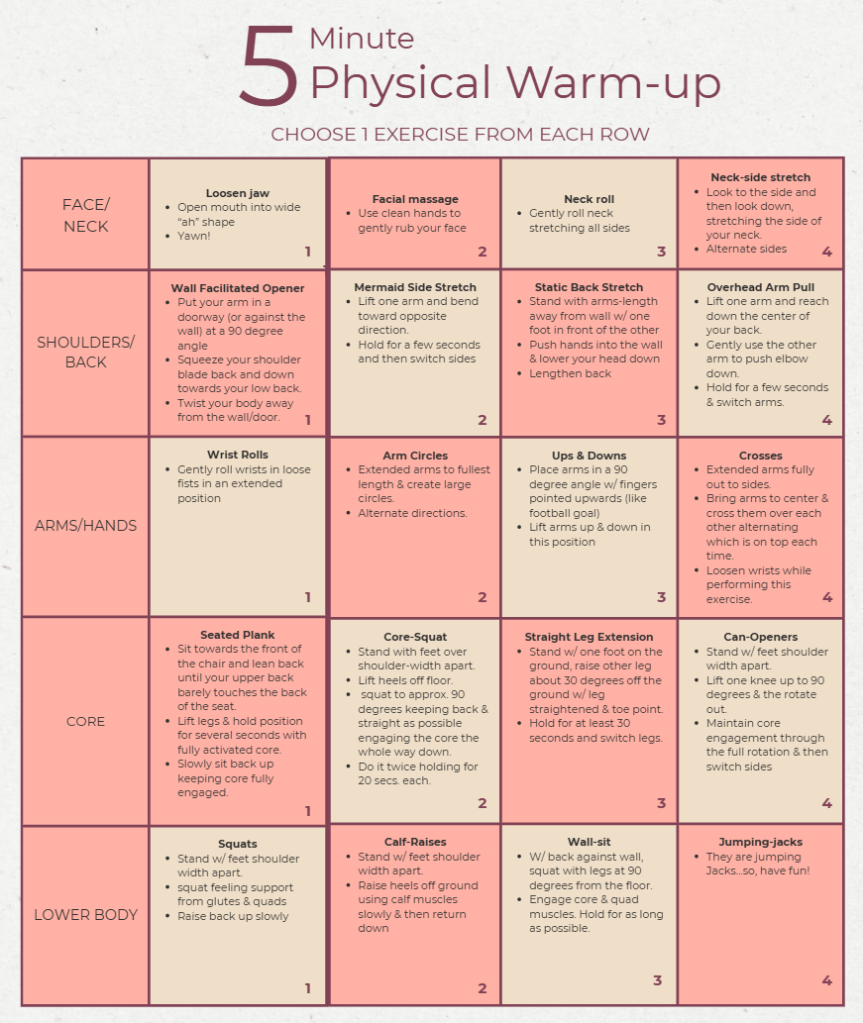
Physical Warm-Up: Preparing the Body
Before touching the instrument, musicians should engage in:
- light movement
- stretching
- breathing awareness
- posture alignment
This phase transitions the body into a ready, responsive state for practice.
Chart instructions:
- The chart is divided into 5 categories Each category represents a different aspect of preparation Choose one exercise per category and perform each exercise for approximately 1 minute
- (You may adjust timing depending on your needs)
- Please follow the same instructions for each chart.
Flute Warm-Up: Connecting with the Instrument
Flute warm-ups serve as a second layer of preparation.
They help establish:
- stable posture and alignment
- controlled breathing
- relaxed embouchure
- focused tone production
This stage ensures that musicians are physically and mentally prepared before beginning repertoire.
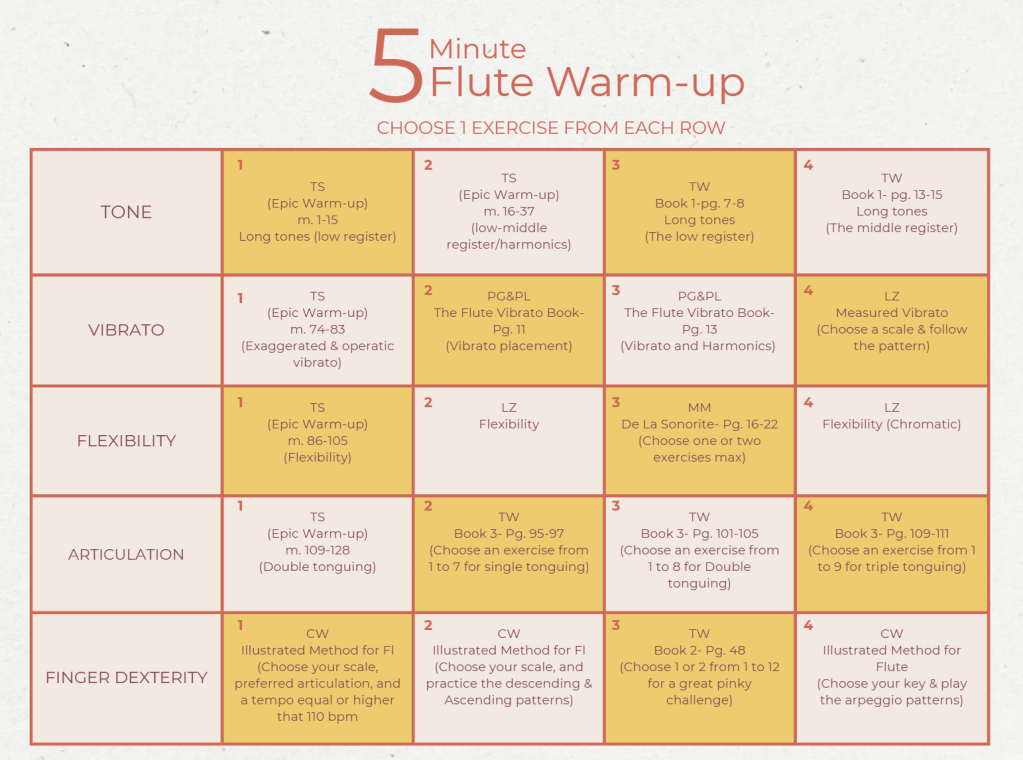
📝 Additional Notes on Chart References & Materials

In addition to the instructions above, you will find several initials throughout this and the next chart. These initials correspond to the composers and pedagogues whose materials are referenced in this project:

TS — Dr. Terri Sanchez
TW — Trevor Wye
PG & PLG — Patricia George and Phyllis Louke
LZ — Dr. Laura Zambrano
CW — Celso Woltzenlogel

These references are included to clearly attribute the pedagogical and technical sources that inform each exercise within the warm-up system.

At the end of this article, in the Sources section, you will also find a link to a Google Drive folder containing all supporting materials listed in the charts. This includes additional references, exercises, and related resources for further exploration.

Enjoy exploring, practicing, and adapting the material to your own routine.
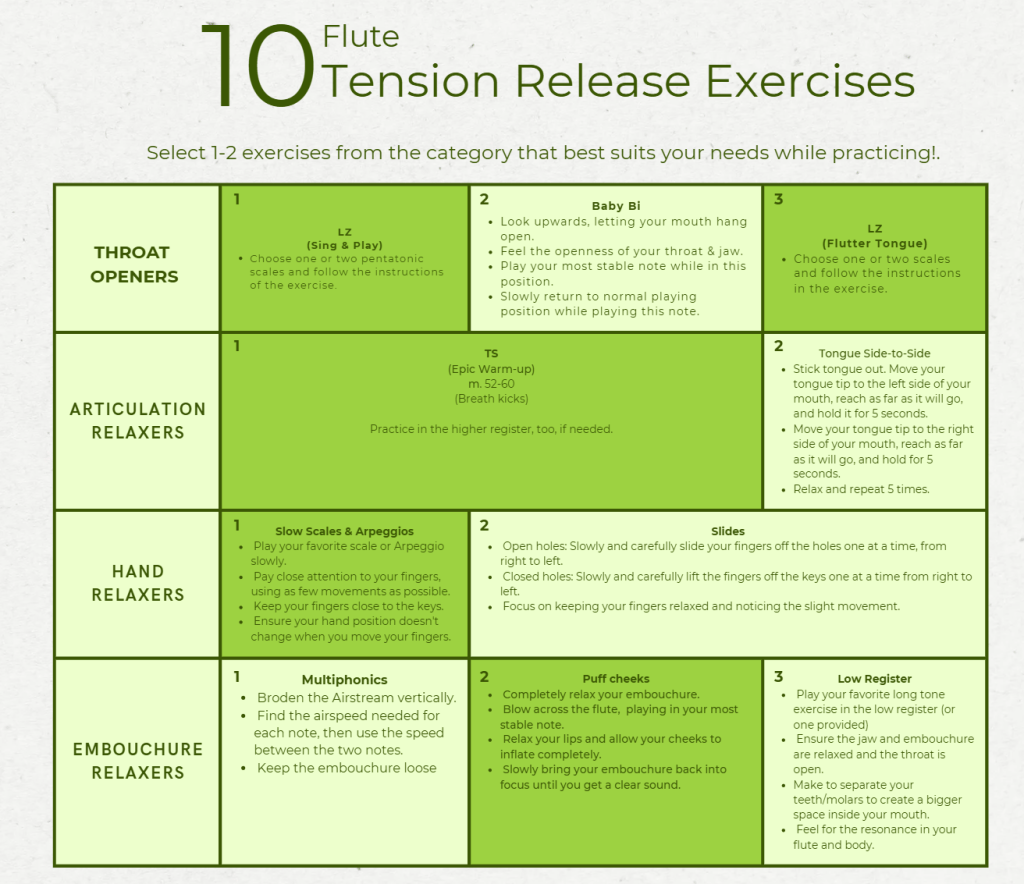
Tension-Release: Managing Physical Stress
During practice, tension can accumulate in the body and negatively affect performance.
Tension-release exercises help:
- reduce muscular strain
- restore balance and alignment
- improve circulation
- prevent fatigue from accumulating
These exercises are designed to be simple, quick, and practical within a rehearsal setting.
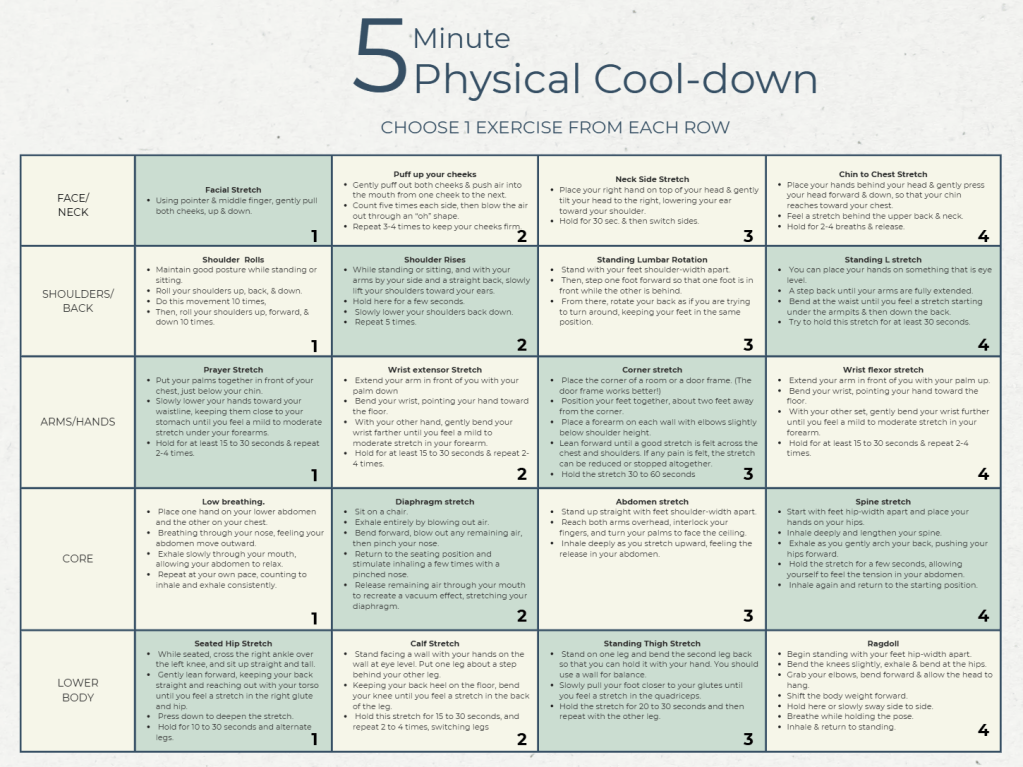
Cooling Down: An Essential Final Step
Cooling down is often overlooked but plays a critical role in recovery.
A proper cool-down:
- reduces physical intensity gradually
- lowers heart rate safely
- supports muscle recovery
- transitions the body into rest mode
Even five minutes of cool-down activity can significantly improve physical recovery after practice.
As noted by the Mayo Clinic, warm-ups and cool-downs may not eliminate injury risk, but they support safe transitions into and out of physical activity.
Final Reflection: Musicians Are Athletes Too
At the core of this approach is a simple truth:
Musicians are physical performers.
Every practice session is a physical act that requires preparation, awareness, and recovery.
By adopting an athletic mindset, musicians can:
- reduce injury risk
- improve performance efficiency
- extend their careers
- develop healthier practice habits
The Flutist Handout was created by flutists, for flutists, with one goal:
To make healthy, sustainable practice accessible—even in limited time.
It is a starting point for building awareness and developing long-term physical care in musical practice.
When time allows, go beyond the minimum. Stretch more. Reset more deeply. And above all, listen to your body.
Sources:
“Aerobic Exercise: How to Warm-up and Cool-Down.” Mayo Clinic. Accessed on March 08, 2024. https://www.mayoclinic.org/healthy-lifestyle/fitness/in-depth/exercise/art-20045517
Burmeister, Chuck. “No. 12: Yoga Minute: Seated Chair Twist A.” YouTube Video, 1:40. July 23, 2015.
https://www.youtube.com/watch?v=HwAkRrqbXo8&ab_channel=YogaChuckbyChuckBu rmeister
Dapena Ortíz, José. “Calentamiento En Músicos – Blog Del Hospital De Manises.” Hospital Manises. Hospital Manises, October 30, 2018.
“Face and Tongue Stretches for Musicians.” Music Bayside. November 24, 2020. Accessed February 29, 2024. https://musicbayside.com/face-and-tongue-stretches-for-musicians/
“Five Quick Cool-Down Stretches.” Well Stated. February 1, 2021. Accessed February 29, 2024. https://www.canyonranch.com/well-stated/post/5-quick-cool-down-stretches/
Futter, Amanda. “The importance of Warm-ups for Flutists.” Learn Flute Online. Accessed on March 08, 2024. https://learnfluteonline.com/the-importance-of-warm-ups-for-flutists/
George, Patricia, and Phillys A. Louke. The Flute Vibrato Book. New York City: Carl Fischer Music Publisher, 2016.
Gonzalez Portillo, Teresa. “Las Lesiones Más Frecuentes En Músicos.” Gran Pausa, April 17, 2017. https://www.granpausa.com/2016/03/31/las-lesiones-mas-frecuentes-en-musicos/
“It’s all About Blood Flow!” University of Rochester Medical Center: Physical and Sports Therapy Blog, April 01, 2022. Accessed on March 08, 2024.
https://www.urmc.rochester.edu/MediaLibraries/URMCMedia/noyes/migrated media/PT-Blog-April_1.pdf
Jordan, Patry. “Estiramientos de Todo el Cuerpo Para Después del Entrenamiento.” YouTube Video, 12:18. February 25, 2015.
Junquera, Iñigo. “FisioOnline.” YouTube. YouTube. Accessed March 1, 2023. https://www.youtube.com/@FisioOnline.
Liebscher & Bracht. “Breathing Wrong: Most People Breathe Incorrectly.” YouTube Video, 13:24. September 27, 2020. https://www.youtube.com/watch?v=ofaU
rzCKwc&ab_channel=Liebscher%26Bracht%E2%80%93ThePainSpecialists Moyce, Marcel. De la Sonorité. Paris: Alphonse Leduc, 1934.
Sanchez, Terri. “Epic Flute Warm-up.” Terriflute.com. January, 2014. Accessed February 29, 2024. https://drive.google.com/file/d/1wF0IzotByYofWU87ysIfQtjAW2HJRuhn/view
Saviddo, Paola. Teaching The Whole Musician. New York: Oxford Press, 2021.
Todorova , Mariana, and Juan Reque. “Músicos y Lesiones Crónicas.” Melómano Digital – La revista online de música clásica, September 4, 2020. https://www.melomanodigital.com/musicos-y lesiones-crónicas/
“Tongue Range of Motion Exercises.” UMMC Health Care. Accessed on March 08, 2024. Trevor, Wye. The Practice Book for the Flute. London: Novello, 2006.
What Is TMJ and How Is It Treated? YouTube. YouTube, 2018.
“Warm-up and Cool-down.” NHS Inform. Last updated, December 01, 2022. Accessed on March 08, 2024. https://www.nhsinform.scot/healthy-living/keeping-active/before-and-after exercise/warm-up-and-cool-down/
Wolzenlogel, Celso. Illustrated Method for the Flute. Brazil: Irmãos Vitale, 1995.
Presentation link: https://www.canva.com/design/DAGz__NWJ3I/NvL
U38QM2W1dMmctNB4pg/view?utm_content=DAGz__NWJ3I&utm_campaign=designshare&ut m_medium=link2&utm_source=uniquelinks&utlId=h7f7291b024
Music Material: https://drive.google.com/drive/folders/1-Li7qAggh_JLawuLJHfLKCm207_-z4Du?usp=drive_link
 Laura Zambrano, Flute
Leave a comment